
CANA’s 2026 Annual Statistics Report puts the US cremation rate at 62.8% in 2025 and confirms a deceleration phase that will push the national rate to a plateau near 80%. For funeral home directors, the strategic implications cut across revenue model, capacity planning, and brand positioning — and they now diverge sharply between rapid-growth and plateau-stage states.
The growth thesis that defined US deathcare strategy is closing out
Cremation has driven US deathcare strategy for two decades. The trajectory looked one-way: every annual CANA report extended the curve upward, and most operators planned capacity, marketing, and pricing around continued growth. That trajectory has now bent.
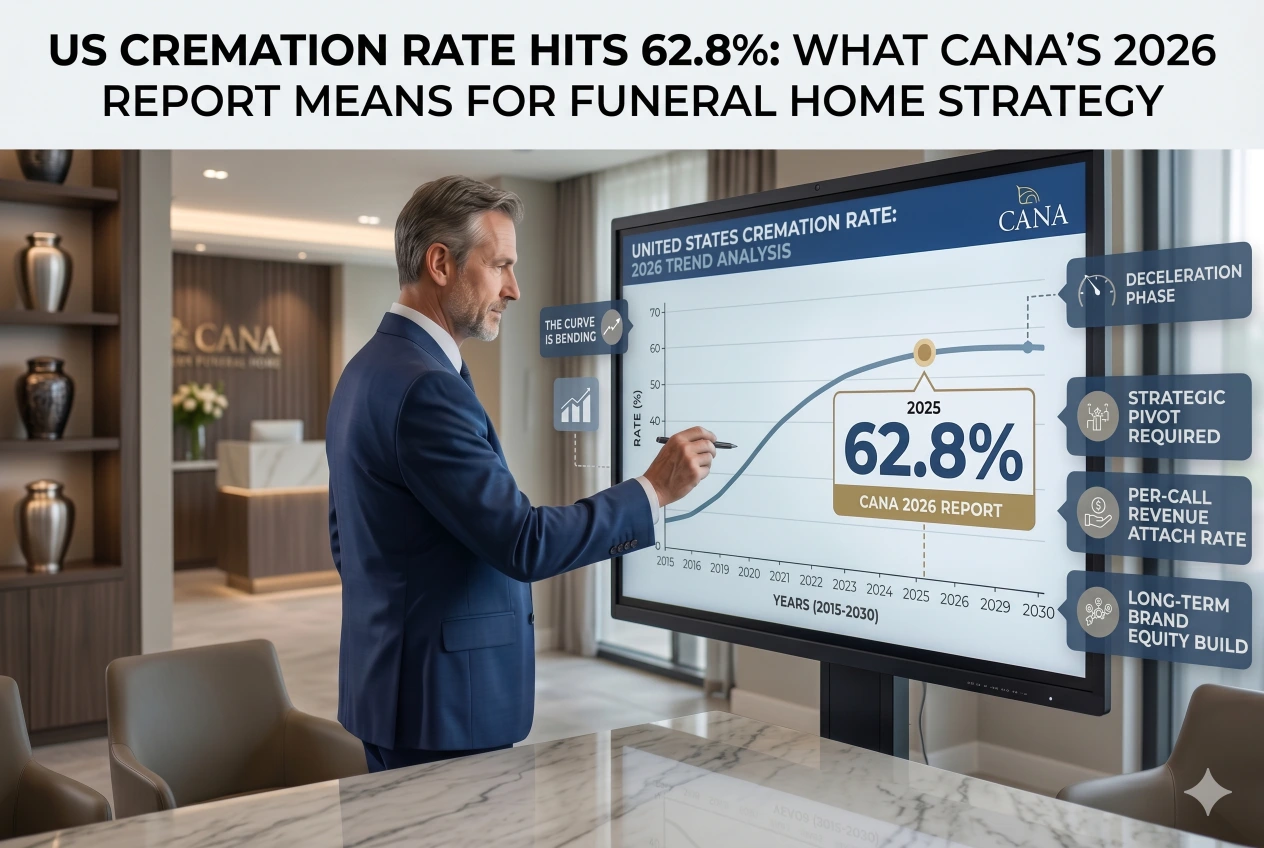
The 2026 Annual Statistics Report from the Cremation Association of North America, released May 26, places the US cremation rate at 62.8% in 2025 and confirms that the pace of growth is slowing. The deceleration phase the association has been forecasting is no longer ahead of the industry — it is here.
The five-year average growth rate has dropped to 1.33%, down from 1.58% in the previous five-year window. The national rate is projected to reach 69.1% by 2030. Once a state crosses the 80% threshold, year-over-year growth essentially flattens. Washington, Nevada, and Oregon are already at or near that ceiling.
The strategic story for the next decade is no longer about adoption. It is about what funeral homes do when the curve stops doing the work for them.
The structural cause: S-curve mechanics, not market disruption
The deceleration is not a market shock. It is the predictable mechanics of an adoption S-curve playing out on a 50-year timeline.
Cremation, like most irreversible consumer-behavior shifts, follows a consistent arc: a long incubation period below 5%, rapid acceleration once that threshold is crossed, and deceleration as the addressable market saturates. The US passed 5% in the early 1970s and 50% in 2015. Canada — which the US trails by roughly 15 years — reached 77.4% in 2025 and is projected at 81.1% by 2030. Canada is the working model for what late-stage US cremation looks like.
A common counter-thesis — that alkaline hydrolysis (AH) and natural organic reduction (NOR) would carve out share fast enough to redirect the curve — has not held up. Combined, AH and NOR account for 0.3% of dispositions in the states where they are practiced and 0.1% nationally. They are not yet moving the cremation curve.
| Phase | Cremation Rate Range | Annual Growth | Strategic Posture |
|---|---|---|---|
| Rapid growth | Below 60% | Above 2% | Capacity build, conversion marketing |
| Deceleration | 60–80% | 1.0–1.5% | Per-service value, mix optimization |
| Plateau | Above 80% | Below 0.5% | Margin defense, peripheral revenue |
The revenue implication: per-call value is now the only growth lever
The most consequential implication of the report is commercial. For the past two decades, the cremation curve carried revenue with it. Converting a burial customer into a cremation customer reduced average revenue per call, but rising cremation volume offset the unit-economics hit. That offset is shrinking.
Five-year average cremation growth has dropped to 1.33%, from 1.58% in the previous five-year period. For operators in deceleration- and plateau-phase states, volume growth is no longer a reliable top-line lever.
When volume stops doing the work, the only remaining lever for top-line growth is average revenue per call. That puts arrangement-room economics under direct strategic scrutiny: which services attach, at what margin, with what consistency. Peripheral revenue — celebration-of-life venues, catering, premium urns, memorial events, aftercare programs — moves from a nice-to-have to a structural source of operating margin. Operators who built around direct-cremation volume at low ARPU now face the same maturity squeeze that reshaped retail and telecom decades earlier.
The operational response: a phased playbook by state market
The operational consequence of the report is that the US national average has become a misleading reference point. The real question is which phase a funeral home’s local market sits in — and the operating model must match the phase, not the headline.
Rapid-growth markets (state rate below 60%)
- Continue capacity investment in retort utilization and cremation-prep workflow.
- Treat first-call marketing and pre-need conversion as the primary growth lever.
- Track conversion velocity from burial to cremation as the leading KPI.
Deceleration markets (60–80%)
- Shift the operating model from volume to value engineering: average revenue per call, attach rates, package mix.
- Rebuild arrangement-room scripts and pricing architecture around bundled experiences rather than disposition method.
- Train arrangers on selling memorial design and service depth, not menu choices.
Plateau markets (above 80%)
- Defend gross margin through peripheral revenue and disciplined fixed-cost review.
- Audit cost structures sized for prior growth assumptions; pre-need and pre-arrangement workflows often carry legacy overhead.
- Lean into community programming, repeat-family relationships, and reputational depth.
The forward outlook: the brand contest moves off the disposition decision
The next decade of US deathcare will not be decided by disposition choice. With cremation projected at 69.1% nationally by 2030 — and well above that in mature states — the choice between burial and cremation will be neither novel nor differentiating. The brand contest moves to a different battlefield.
What will distinguish funeral homes in the deceleration and plateau phases is service depth, trust, and the quality of the family relationship before and after the service. The disposition decision becomes a logistical default; the cultural and emotional architecture around it becomes the product. Funeral home brand equity will increasingly be built on continuity — pre-need conversations, the arrangement experience, post-service aftercare, community presence — rather than on which method is offered.
The funeral homes best positioned for the next ten years are the ones that stop treating cremation as a strategic variable and start treating the family experience around it as their core asset. The slowdown of the curve is the signal that the slow rebuild has begun.
One more thing — if you work in the funeral industry, this might interest you. At Lumina, we transform the traditional guest book into a Digital Memory Capsule: a private space where family and friends can drop messages, photos, audio, and videos that automatically convert into an HD tribute video, under your funeral home’s name and logo. A service you activate in under a minute, that families deeply value, and that adds a new revenue stream to every service — with no extra operational burden, no subscriptions, and no technical complications. Want to try it with no obligation? Sign up at Lumina Memorials and activate your first 3 free capsules.
#FuneralIndustry #DeathCare #CremationStatistics #CANA #FuneralHomeStrategy #CremationTrends #FuneralServices #FuneralDirectors #FuneralIndustry2026 #DeathCareTrends #FuneralBusiness #MemorialServices #FuneralInnovation #ArrangementRoom #PerCallRevenue #FutureOfFunerals #FuneralOperations
Original source: https://www.cremationassociation.org/industrystatistics.html